It does help, and not for the reason it is usually sold. What the mechanism actually is, how to structure it for PCOS specifically, and what it will not do.
Reviewed by Dr. Grishma Ranjangaonkar, MBBS, DGO, ICOG Fellowship in Gynecological Endoscopy · Eva WomanCare Clinic, Vashi, Navi Mumbai
This question comes up in clinic almost every week, usually after a video claiming that particular postures act on the ovaries. The honest answer is more useful than the marketed one: Surya Namaskar helps in PCOS because regular whole-body movement improves insulin sensitivity, and insulin sits at the top of the loop that drives the condition.
The short version
Yes, and not for the reason it is usually sold. Surya Namaskar helps in PCOS because it is sustained, whole-body movement done regularly, and regular movement improves insulin sensitivity. That is the mechanism. There is nothing specific about the sequence that acts on the ovaries, no posture that corrects a hormone, and no evidence for the claim that particular asanas “stimulate” the endocrine system in the way the wellness internet suggests.
None of that makes it less useful. It makes it useful for honest reasons, and honest reasons are more durable, because they tell you what to expect and how long to give it.
PCOS runs on a loop. Insulin resistance raises circulating insulin, higher insulin pushes the ovaries to produce more androgen, that disrupts the maturing of follicles, and ovulation becomes irregular. Exercise interrupts the loop at the first step.
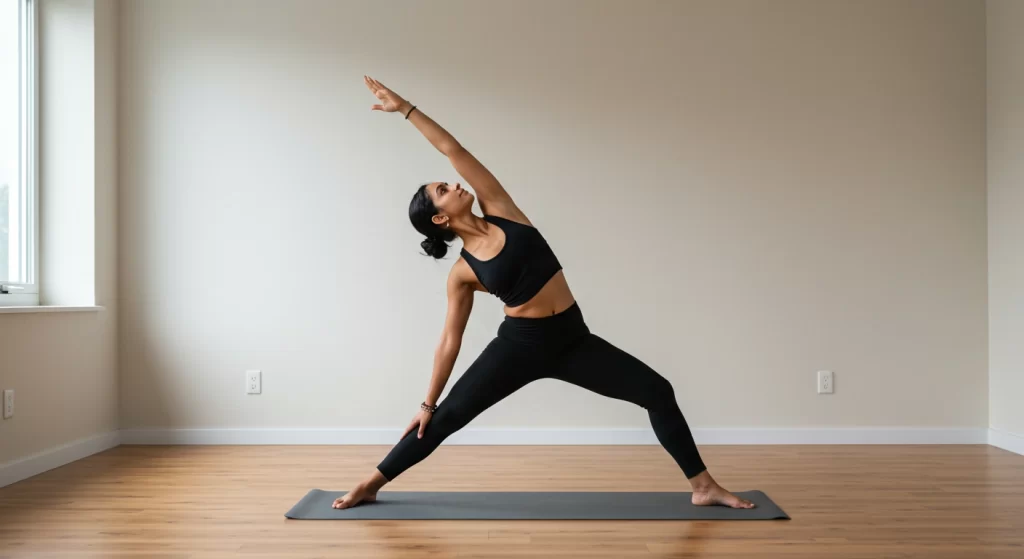
Advice on Surya Namaskar usually comes from a yoga tradition rather than from a metabolic one. For PCOS specifically, these are the things that matter.
|
|
What to aim for
|
Why
|
|---|---|---|
Our PCOS and PCOD guide sets out how the diagnosis is actually made and what treatment adds on top of lifestyle, and the PCOS risk assessment is a twelve-question starting point if nobody has formally assessed you yet.
Myth
“Certain asanas stimulate the ovaries directly.”
What is actually true
There is no mechanism for this and no evidence behind it. The benefit of yoga in PCOS comes from regular whole-body movement improving insulin sensitivity, plus its effect on stress and sleep. That is a genuinely good reason, and it does not need embellishing.
Myth
“Twelve rounds a day will regulate your cycle within a month.”
What is actually true
Cycle patterns shift over three to six months, not weeks. Expecting a fast result is the commonest reason women stop before the change would have shown.
Myth
“If you do yoga you do not need medication.”
What is actually true
For some women lifestyle alone restores ovulation. For many it does not, and ovulation induction tablets are effective, safe and not a failure of willpower. The two work together rather than competing.
Myth
“Surya Namaskar is enough on its own.”
What is actually true
It is excellent cardiovascular and mobility work. Adding resistance training twice a week does more for insulin sensitivity over time, and a short walk after meals adds a separate benefit again.
Myth
“You should not exercise during your period.”
What is actually true
You can, and many women find it helps cramps. Adjust the intensity to how you feel rather than stopping on principle.

Physical activity targets and the role of weight change in PCOS follow the International Evidence-Based Guideline for the Assessment and Management of Polycystic Ovary Syndrome, which recommends at least 150 minutes of moderate activity a week and notes that a modest reduction in weight improves ovulation and metabolic markers in women who are above a healthy weight. Yoga specifically has been studied in small trials with encouraging but limited results. This article is general information and does not replace an assessment with your own doctor.

Dr. Grishma Ranjangaonkar
MBBS, DGO · ICOG Fellowship in Gynecological Endoscopy · Maharashtra Medical Council Reg. No. 2014041327
Dr. Grishma has more than fifteen years of clinical experience and practises at Eva WomanCare Clinic in Vashi, seeing women from across Navi Mumbai including Kopar Khairane and Turbhe. Her work spans fertility and pregnancy care, PCOS and menstrual health, and keyhole gynecological surgery.
The whole picture: how it is diagnosed, the levers that actually change outcomes, and what treatment involves.
A few minutes of questions to see whether what you are noticing is worth an appointment.
Useful mainly as a starting point, because in PCOS it is the five to ten percent change that matters.
What a normal cycle looks like, and the point at which irregularity is worth investigating.
Movement is one of the four things that genuinely shift PCOS, and it is the one you can start tomorrow morning without anyone else involved. The other three need a scan, a blood panel and someone to read them alongside your cycle history. If you are in Vashi, Kopar Khairane, Turbhe or Nerul, come in and we will run both tracks at once rather than waiting six months to see whether the first one worked.