
What keyhole surgery involves, how to prepare, why your shoulder hurts afterwards, what recovery actually looks like week by week, and the risks with real numbers attached.
Reviewed by Dr. Grishma Ranjangaonkar, MBBS, DGO, ICOG Fellowship in Gynecological Endoscopy · Eva WomanCare Clinic, Vashi
Almost all benign gynecological surgery is now done through three or four small cuts rather than one large one. This guide covers what that means in practice: how to prepare, what the day looks like, which sensations afterwards are expected and which are not, how long each part of normal life takes to come back, and what the published risk figures actually are.
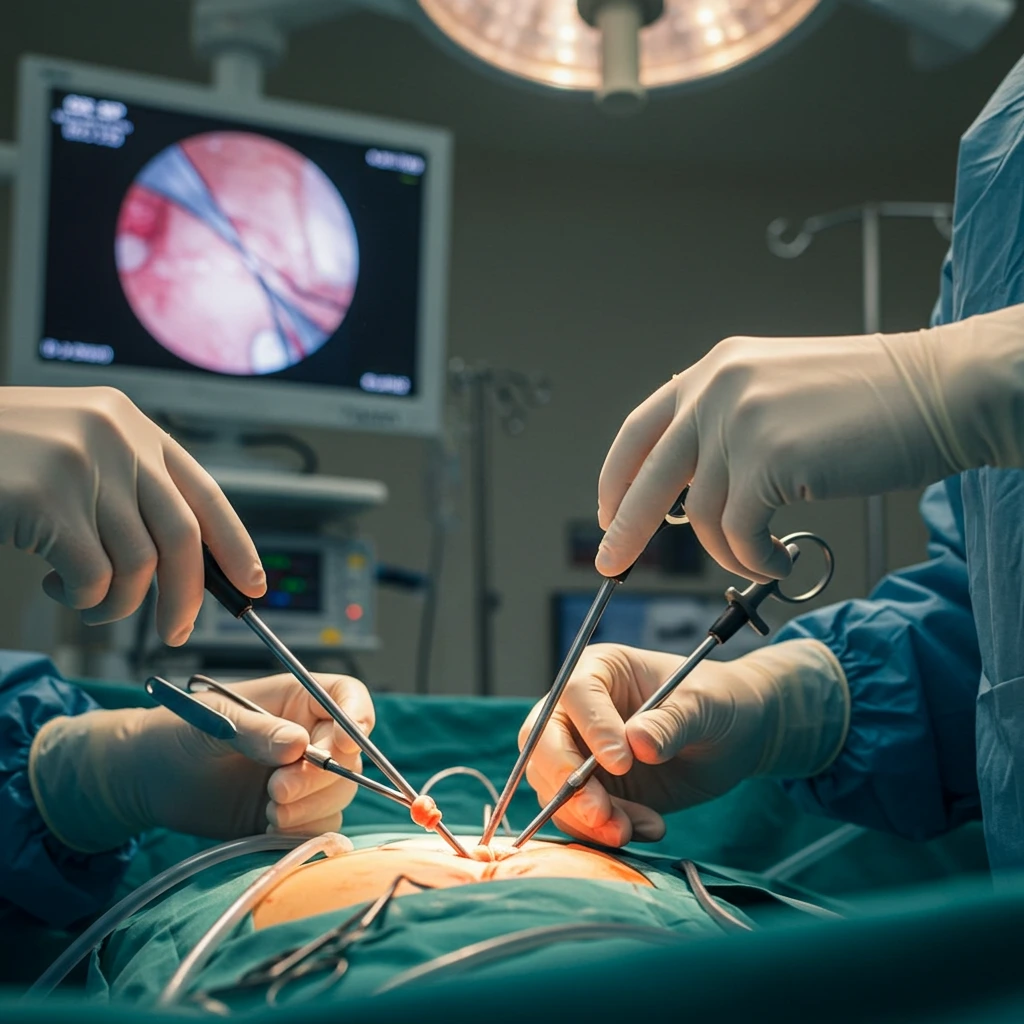
Laparoscopy is surgery done through three or four small cuts instead of one large one. A telescope with a camera goes in through the navel, the abdomen is gently inflated with carbon dioxide to create space to see and work in, and fine instruments pass through the other openings. The surgeon operates while watching a magnified image on a screen. Everything inside is done the same way it would be in open surgery. What changes is how the surgeon gets in and out.
That difference is not cosmetic. Less tissue is cut, so there is less pain, less blood loss, a shorter stay and a faster return to normal life. The current position in guidance is straightforward: where an operation can be done laparoscopically and there is no contraindication, it should be.
The same word covers two quite different experiences, and knowing which one you are consenting to changes what you should plan for.
|
|
Diagnostic laparoscopy
|
Operative laparoscopy
|
|---|---|---|
Almost all benign gynecological surgery can now be done laparoscopically. The list below covers what we do most often.
|
Condition
|
What the operation does
|
Notes worth knowing
|
|---|---|---|
|
|
Laparoscopy
|
Open surgery
|
|---|---|---|
Most of what goes wrong on the day is avoidable and administrative. The list below is what we go through at the pre-operative visit.
For fertility-related laparoscopy, and for a tubal dye test, the operation is usually planned for the first half of the cycle, after a period has finished. If there is any chance of pregnancy, say so, because it changes the plan entirely.
Blood count, blood group, blood sugar, and depending on your age and history an ECG and a physician review. Anaemia is worth correcting before rather than after, because it changes how you feel for the whole recovery.
Blood thinners, some anti-inflammatories and certain supplements need stopping, and the timing differs for each. Bring the full list, including anything bought over the counter. Do not stop anything on your own, particularly thyroid, blood pressure or diabetes medication.
Nothing to eat for six hours before, and clear fluids usually allowed until two hours before, unless you are told otherwise. Fasting longer than instructed does not make it safer and makes you feel considerably worse.
Read what you are signing. It should name the operation, say what will be done if something unexpected is found, and cover conversion to open surgery. This is the moment to ask what will be preserved: the ovary, the tube, the uterus.
Someone to take you home, because you cannot drive after anaesthesia. Loose clothing for going home, since the abdomen is bloated. Sanitary pads rather than tampons. Help at home for two or three days if the operation is more than diagnostic.
From arriving to going home is usually six to eight hours for a day case, most of which is waiting and recovery rather than surgery.
The single most common reason people call the clinic in the first two days is a pain that nobody warned them about, in a place that makes no sense.

|
What you notice
|
Normal
|
When to call
|
|---|---|---|
Recovery after laparoscopy is faster than after open surgery and slower than the size of the cuts suggests. The chart below is a guide to typical windows rather than a set of rules, and what you actually had done matters more than the fact that it was keyhole.
Complications after laparoscopy are uncommon, and the ones that matter almost always announce themselves in the first week. Any of the following is a reason to be seen the same day rather than to wait for the follow-up appointment.
Consent is only meaningful with numbers attached. The figures below are the Royal College of Obstetricians and Gynaecologists consent advice for diagnostic laparoscopy, which is the cleanest published set available. Operative laparoscopy carries the same risks at a somewhat higher rate, because the operation is longer and more is being done.
|
Risk
|
How often
|
What it means
|
|---|---|---|
Endometriosis is the commonest reason we perform laparoscopy, and it is the area where the details of how the operation is done matter most for what happens next.
Myth
“Small cuts mean a small operation.”
What is actually true
The cuts are small; the operation inside is exactly the same size. A laparoscopic hysterectomy is a major operation performed through keyholes. Judging your recovery by the size of the dressings is the most common mistake people make, and it is why the tiredness in week two takes them by surprise.
Myth
“The shoulder pain means something has gone wrong.”
What is actually true
It means gas is still under the diaphragm irritating a nerve that shares a route with the one from your shoulder. It is expected, it peaks around day one or two, and walking is the best thing for it. Pain that worsens after day four is a different matter and should be reviewed.
Myth
“Converting to open surgery means the surgeon failed.”
What is actually true
It means the surgeon judged that continuing through keyholes was not safe for you, and acted on that. Dense adhesions and bleeding are the usual reasons. A surgeon who converts when it is warranted is doing the job properly.
Myth
“A normal scan rules out endometriosis.”
What is actually true
It does not. Ultrasound reliably shows endometriomas and larger deep disease, and reliably misses superficial peritoneal deposits, which are common and can be painful. This is precisely the situation where laparoscopy answers a question imaging cannot.
Myth
“Laparoscopy will fix my fertility.”
What is actually true
Sometimes, and specifically: dividing adhesions, treating endometriosis and removing a hydrosalpinx before IVF all help. But laparoscopy is not a fertility treatment in itself, and having one done in the hope that it might help, without an indication, is not the right reason to have an operation.
None of these is confrontational. All of them have specific answers, and asking them tends to make the whole conversation better.

Risk frequencies are from the Royal College of Obstetricians and Gynaecologists Consent Advice No. 2, Diagnostic Laparoscopy. Recommendations on surgical management of endometriosis, including excision versus ablation and treating at the time of diagnosis, follow NICE guideline NG73. Return-to-activity windows are typical post-operative ranges rather than guideline figures, and your surgeon’s instructions take precedence. This guide is general information and does not replace advice from your own doctor, who has your history and your results.
Where laparoscopy fits in a fertility investigation, and what the other tests answer first.
Irregular cycles, ovarian appearance on a scan, and why a polycystic ovary is not a surgical problem.
Including why a hydrosalpinx is usually treated before a cycle rather than after a failed one.
If you are not yet sure whether what you have needs a same-day visit or a routine one.
If you have been advised to have an operation and are not sure it is the right one, or you want to understand what will be removed and what will be preserved, that is a conversation worth having before the date is booked rather than after.