A chart answers a question about quantity, and the first trimester is almost entirely a question about four specific nutrients. Here is what we actually go through at a first visit.
Reviewed by Dr. Grishma Ranjangaonkar, MBBS, DGO, ICOG Fellowship in Gynecological Endoscopy · Eva WomanCare Clinic, Vashi, Navi Mumbai
The request behind this one is rarely about food. It is about wanting some certainty that nothing is being done wrong, in the twelve weeks when almost everything feels uncertain. A printed chart is a poor way to deliver that certainty, because in the first trimester the amount you eat barely changes at all. What changes is a short list of nutrients that have to be there every single day.
The short version
Almost every woman who asks us for a first trimester diet chart is asking for the same underlying thing: some certainty that she is not accidentally harming the pregnancy. That is a reasonable thing to want. A printed chart is just a poor way of delivering it, because it answers a question about quantity when the first trimester is almost entirely a question about a handful of specific nutrients.
Here is the part that surprises people. In the first twelve weeks you do not need to eat more. Not one extra portion. UK guidance puts the extra requirement at roughly two hundred calories a day and only in the final three months, which is about a banana and a glass of milk. Everything before that is the same amount of food you were already eating.
So a chart built around portions solves a problem you do not have, and it usually collapses in week seven anyway, when nausea decides what you eat. What follows is what we actually go through at a first visit, in the order we go through it.
|
What
|
How much
|
Why it matters this early
|
|---|---|---|
Two more sit slightly behind those. Iron demand rises across the pregnancy and the national programme supplies iron and folic acid together, but iron on an empty first-trimester stomach is a reliable way to make nausea worse, so timing is worth discussing rather than pushing through. And vitamin B12 deserves a specific mention here, because a large share of our patients eat little or no animal food and B12 comes almost entirely from animal sources. Our pregnancy nutrition guide goes through each of these across all three trimesters.
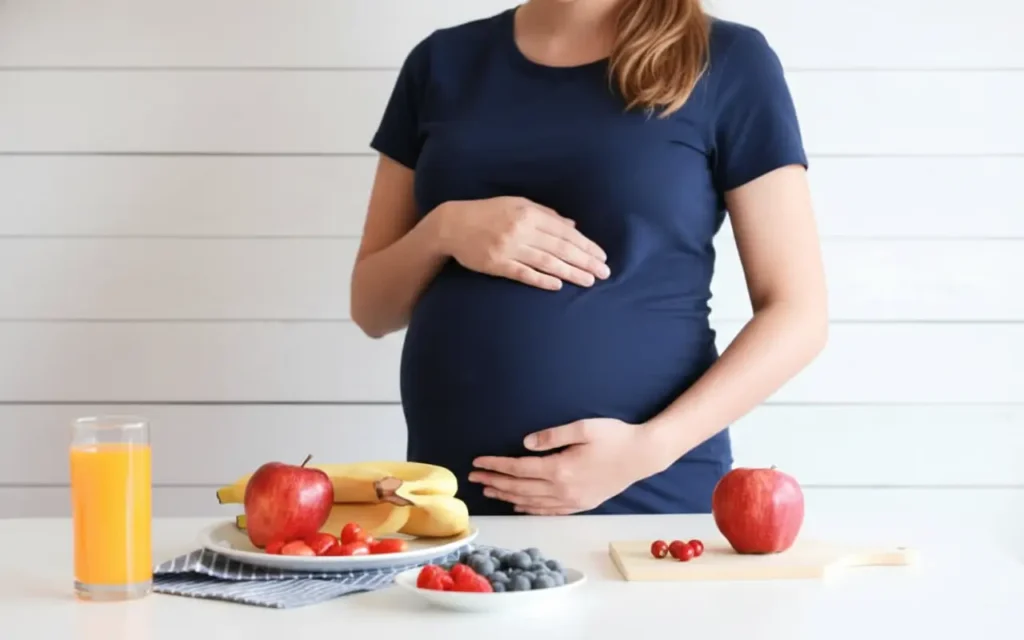
This is closer to what a useful chart looks like: not grams and portions, but a shape for the day that still works when you feel terrible. Sickness peaks somewhere around weeks eight to eleven for most women and settles by fourteen. Until then the goal is calories and fluid, and the nutrition can be less than perfect without anything going wrong.
|
When
|
What works when you feel sick
|
Why
|
|---|---|---|
Persistent vomiting with no fluids staying down, weight loss, dark and scanty urine or feeling faint on standing points to hyperemesis rather than ordinary sickness, and it is treated rather than endured. Anti-sickness medication in pregnancy is well established and safe, and vitamin B6 helps a meaningful number of women. There is no prize for suffering through it.
This list is shorter than the internet suggests, and most of what circulates locally is not on it. The real one is about infection and about vitamin A.
Papaya, pineapple and the rest of the local list are dealt with properly in our article on foods to avoid during pregnancy, along with why most of them are not a problem in the quantities anyone actually eats.

Fair enough. The version that survives contact with real life is not a timetable, it is a shape for the plate, and you apply it to whatever you are already eating rather than replacing your food with a list written for somebody else.
|
Share of the plate
|
What goes there
|
The point
|
|---|---|---|
Myth
“You must eat for two from the moment you find out”
What is actually true
The extra energy a pregnancy needs is about two hundred calories a day, and only in the last three months. Eating for two from week five is the commonest route to gaining more weight than is helpful, which brings its own complications in the third trimester and at delivery.
Myth
“Ghee from the seventh month makes delivery easier”
What is actually true
It does not. There is no evidence that dietary fat softens the birth canal or shortens labour, and the extra calories arrive at exactly the point in pregnancy where weight gain is fastest anyway. Eat ghee because your food tastes better with it.
Myth
“Saffron in milk decides the complexion of the baby”
What is actually true
Skin colour is set by genetics and nothing eaten in pregnancy alters it. Saffron milk is harmless and pleasant, and it is worth naming this one plainly because of what the belief implies rather than because of any risk in the drink.
Myth
“Skipping meals when you feel sick is fine because you are not keeping it down anyway”
What is actually true
An empty stomach makes nausea distinctly worse, and this is the loop that lands women in hospital on a drip. Small, frequent, bland and cold is the strategy, and dry biscuits before you sit up in the morning is the single most effective piece of advice we give.
Folic acid at 400 micrograms daily until twelve weeks, the 5 milligram dose for higher-risk groups, and vitamin D at 10 micrograms daily follow NHS and NICE guidance on vitamins and supplements in pregnancy. The figure of roughly 200 extra calories a day in the final trimester follows UK dietary guidance. Advice on nausea, vomiting and hyperemesis follows RCOG guidance. This article is general information and does not replace an assessment with your own doctor, particularly if you have diabetes, thyroid disease, a restricted diet or a previous pregnancy complication.

Dr. Grishma Ranjangaonkar
MBBS, DGO · ICOG Fellowship in Gynecological Endoscopy · Maharashtra Medical Council Reg. No. 2014041327
Dr. Grishma has more than fifteen years of clinical experience and practises at Eva WomanCare Clinic in Vashi, seeing women from across Navi Mumbai including Kopar Khairane and Turbhe. Her work spans fertility and pregnancy care, PCOS and menstrual health, and keyhole gynecological surgery.
All three trimesters, nutrient by nutrient, written around Indian food rather than around portions.
What is normal week by week in the first twelve, and the signs that need a call today.
Ghee, saffron, papaya and the rest, taken one at a time.
Work out your dates and which week you are actually in.
One prescription, three blood tests and a dating scan answer more than any chart can. If you are newly pregnant in Vashi, Kopar Khairane, Turbhe or Nerul, book the booking visit rather than reading another list. It is a single appointment and it sets up the whole pregnancy.