GUIDE

Pregnancy Nutrition Guide

How much extra to eat, which nutrients actually matter, and why the timing of your tea decides how much iron you absorb.

Reviewed by Dr. Grishma Ranjangaonkar, MBBS, DGO, ICOG Fellowship in Gynecological Endoscopy · Eva WomanCare Clinic, Vashi

Eating for two is the most expensive piece of advice in Indian pregnancy. Energy needs rise far less than families assume, while the demand for iron, folate, calcium and protein climbs steeply. This guide is about closing that gap in an ordinary Indian kitchen.

What this guide covers

How much extra you actually need to eat

The instruction to eat for two is the most expensive piece of bad advice in Indian pregnancy. Energy needs rise, but far less than most families assume, and the rise is not evenly spread across the nine months. What genuinely doubles is the demand for specific nutrients, at exactly the stage when nausea makes eating hardest.
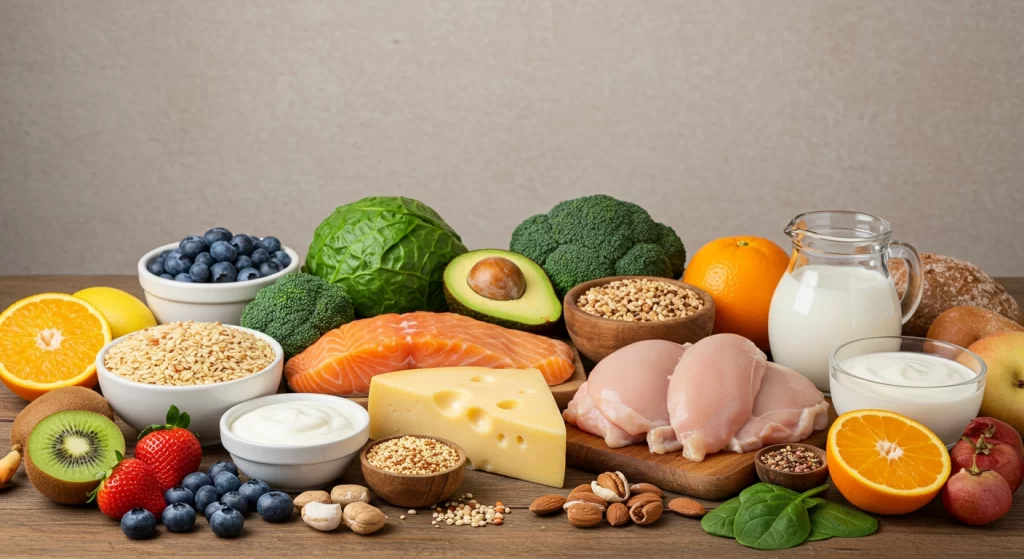
A variety of healthy foods including fruits, vegetables, dairy products, lean meats, and grains, arranged on a table, representing nutritious options for pregnancy.
What rises steeply in pregnancy is the demand for iron, folate, calcium and protein. Energy needs barely move by comparison.

The nutrients that matter, and when

Week of pregnancy →0481216202428323640Folic acidIodineProteinIronCalciumDHA omega-3Peak demandNeeded throughoutDoses are set by your doctor. This shows when each nutrient is doing its most important work.
When each nutrient is doing its most important workThe solid bar is the window of peak demand. Folic acid and iodine matter most before most women have had a first appointment, which is exactly why supplements start early.
Nutrient
What it does
Where to get it in an Indian kitchen
Worth knowing

What a day of eating actually looks like

Curd ormilkHalf the plateVegetables and fruit, ideally more than one colourA quarterGrains and millets: rice, roti, ragi, oatsA quarterDal, rajma, egg, fish, chicken or paneerProportions, not portions. A pregnancy thali is the usual one with the vegetable share increased and the protein made deliberate.
The pregnancy plateProportions rather than portions. This is the ordinary Indian thali with the vegetable share increased and the protein made deliberate instead of incidental.

The pattern that matters is smaller and more frequent rather than three large meals, particularly once heartburn and reduced stomach room arrive in the third trimester. Two to three litres of fluid a day, mostly water. Do not cut fluids to reduce trips to the bathroom, because dehydration triggers Braxton Hicks tightenings and makes constipation worse.
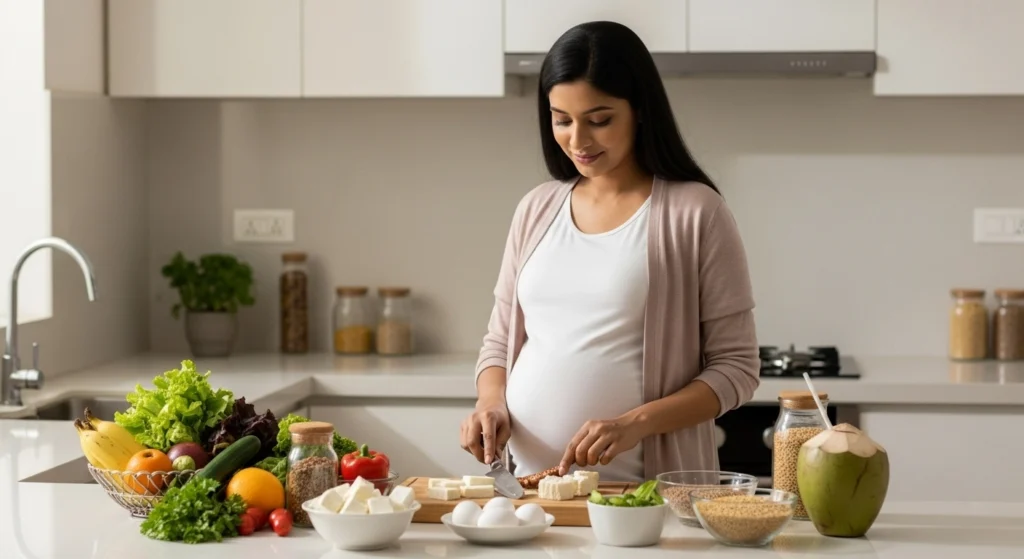
Foods in pregnancy
Smaller and more frequent works better than three large meals, particularly once stomach room runs short in the third trimester.

Iron, anaemia and the tea problem

India has one of the highest rates of anaemia in pregnancy in the world, and it is the single most fixable nutritional problem we see. Anaemia makes you exhausted and breathless, raises the risk of a small baby and preterm birth, and makes any bleeding at delivery far more dangerous than it would otherwise be.

Pregnant woman holding a coffee mug by a sunlit window
Tannins in tea block iron absorption. Moving chai an hour away from meals is the single most useful change in most Indian households.

Most women know they should take iron. Far fewer know that when you take it decides how much of it reaches your blood.

Helps absorptionVitamin C with the meal: lemon, amla, guavaCooking in an iron kadai or panSprouted or fermented pulsesMeat, fish or egg alongside plant ironBlocks absorptionTea or coffee within an hour of eatingCalcium tablets at the same time as ironVery high-fibre or bran-heavy mealsAntacids taken with the iron tabletHow much iron your bodyactually takes upMore iron,less anaemiaThe single most useful change in most Indian households: move tea and coffee away from mealtimes.
What helps and what blocks iron absorptionPlant iron is poorly absorbed to begin with, which is why the things around the meal matter as much as the meal.

What is actually prescribed, and why

WHO recommends daily iron and folic acid supplementation as part of routine antenatal care, suggesting a supplement containing 30 to 60 mg of elemental iron, with the higher end preferred where anaemia is common. India sits firmly in that higher band, which is why the dose you are given here is usually at the top of the range rather than the bottom. Calcium supplementation is also recommended by WHO where dietary calcium intake is low, because it lowers the risk of pre-eclampsia.

Eating when you cannot keep anything down

In the first trimester the right goal is not a balanced diet. It is fluids, and whatever calories you can hold. Nutritional balance can be recovered in the second trimester. Dehydration cannot wait.

Vegetarian and vegan pregnancies

A vegetarian pregnancy is entirely workable and extremely common in India. It just needs three specific gaps closed deliberately, because they will not close on their own.

Eating differently with gestational diabetes

If your glucose tolerance test comes back positive, the great majority of cases are managed with diet and monitoring alone. The principle is not eating less, it is changing what the carbohydrate is and what it is eaten with.

Our second trimester guide covers who is at risk and what the test involves.

Foods to avoid, and the ones you can stop avoiding

Things you can stop avoiding, because normal amounts have not been shown to cause harm: ripe papaya, pineapple, curd at night, sour foods, cold water, and whatever your neighbour has warned you about this week. Our myths and facts guide goes through these properly.

Caffeine sits in between. Most guidance puts the limit at around 200 mg a day, which is roughly two cups of instant coffee or three or four cups of tea. The bigger issue with tea in an Indian household is not the caffeine but the timing, because tannins block iron absorption.

Weight gain, and what it should look like

The right total depends almost entirely on your starting BMI, which is why there is no single number. Indian cut-offs classify overweight from a BMI of 23 rather than 25, so many women here are given a lower target than an international chart would suggest. Our BMI calculator shows both scales side by side, and the second trimester guide has the full table by category.

Supplementation guidance follows the World Health Organization, which recommends daily antenatal iron and folic acid containing 30 to 60 mg of elemental iron, the higher dose preferred where anaemia is prevalent, and antenatal calcium where dietary intake is low (WHO Nutrition Landscape Information System; WHO antenatal care recommendations). Your own doses are set by your doctor and may differ. This guide is general information and does not replace individual medical advice.

Tools and guides that go with this

BMI Calculator

Indian and international cut-offs side by side, which is what decides your weight gain target.

First Trimester Guide

Weeks 1 to 12, including eating through nausea and which tests come when.

Second Trimester Guide

The glucose test, gestational diabetes and the full weight gain table by BMI.

Pregnancy Myths and Facts

Papaya, ghee, eating for two and twenty more claims checked against the evidence.

Pregnancy Warning Signs

Sorted by urgency: what means go now, what means call today, and what can wait for your next visit.

Not sure your diet is covering it?

Anaemia and vitamin deficiencies are common here, easy to test for, and much easier to fix early than late. If you are pregnant or planning to be, come in and let us check the bloods rather than guess from a food list.

Nutrition questions we hear most

Essentially none in the first trimester, roughly 350 extra a day in the second, and roughly 350 to 450 in the third. That is one substantial snack, not a second dinner. Breastfeeding needs more than any stage of the pregnancy itself, around 500 extra a day. What rises far more steeply than energy is your requirement for iron, folate, calcium and protein, so the composition matters more than the quantity.
Because India has one of the highest rates of anaemia in pregnancy anywhere, diet alone rarely closes the gap once blood volume rises by almost half, and anaemia raises the risk of a small baby, preterm birth and dangerous bleeding at delivery. WHO recommends daily antenatal iron containing 30 to 60 mg of elemental iron, with the higher dose preferred exactly where anaemia is common. If the tablet is making you nauseous or constipated, say so, because both are fixable.
In moderation, yes. Most guidance puts the caffeine limit at around 200 mg a day, roughly two cups of instant coffee or three to four cups of tea. The bigger issue in an Indian household is timing rather than quantity: tannins in tea block iron absorption, so keeping chai at least an hour away from meals and from the iron tablet is the single most useful change most families can make.
Yes, and it is very common here. It needs three gaps closed deliberately: vitamin B12, which must be supplemented on a purely plant-based diet and checked with a blood test; iron, which is absorbed poorly from plants and needs vitamin C alongside it; and protein, which needs to be made deliberate at every meal rather than incidental. DHA is the fourth on a vegan diet and is worth discussing in the third trimester.
Ripe papaya in normal culinary amounts has never been shown to cause miscarriage in humans. The concern comes from unripe green papaya, whose latex caused uterine contractions in animal studies at doses far beyond anything you would eat. Most first-trimester miscarriages are caused by chromosomal errors present from conception, not by food.
Then aim for fluids and whatever calories you can hold, and let balance wait for the second trimester. Eat before you feel hungry, keep something dry by the bed, favour cold food over hot because smell is the main trigger, and keep taking the folic acid even on the days you eat almost nothing. If you cannot keep fluids down for a full day or are losing weight, that is hyperemesis and needs treating rather than enduring.
Two to three litres a day for most women, more in Mumbai summers or if you are active. Do not cut fluids to reduce trips to the bathroom, which is a common and counterproductive habit. Dehydration triggers Braxton Hicks tightenings, worsens constipation and makes the exhaustion worse. Dark urine is the simplest signal that you are behind.
Call Now WhatsApp