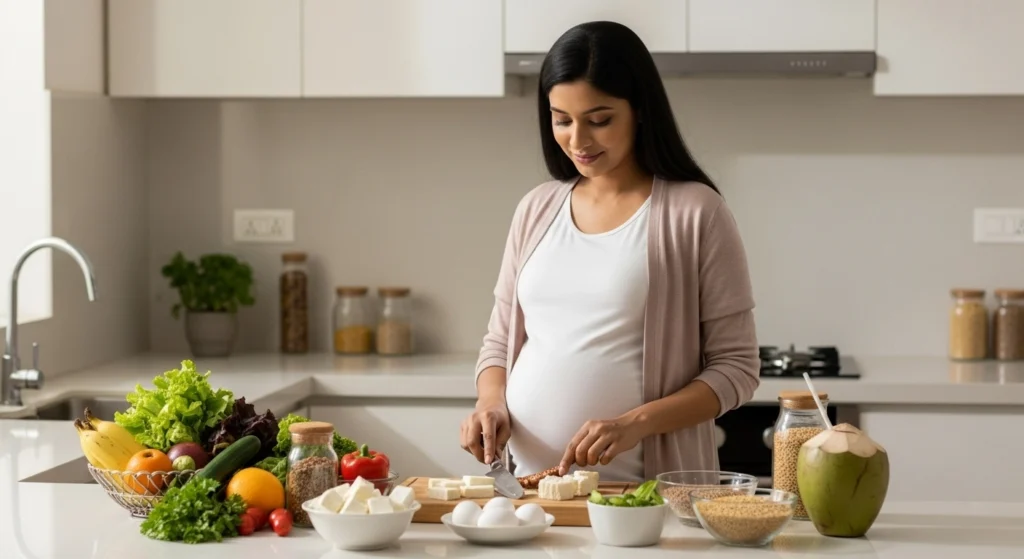
Everything genuinely off the menu is there for one of three reasons. Learn the three and you can answer every piece of advice you are given, including the ones about papaya.
Reviewed by Dr. Grishma Ranjangaonkar, MBBS, DGO, ICOG Fellowship in Gynecological Endoscopy · Eva WomanCare Clinic, Vashi, Navi Mumbai
By the second month of most pregnancies the forbidden list has grown to forty items, assembled from relatives, neighbours and a WhatsApp group. The medical list has about eight things on it, and almost nothing from the local list is on it. The useful skill is not memorising a longer list, it is knowing the three reasons anything ends up on a real one.
The short version
By the second month of most pregnancies, the list of forbidden foods has grown to somewhere between thirty and fifty items, assembled from a mother-in-law, two aunts, a neighbour and a WhatsApp group. The medical list has about eight things on it, and almost nothing from the local list appears on it at all.
The way out of the confusion is not to memorise a longer list. It is to understand that everything on a real avoid list is there for one of three reasons, and to test anything you are told against those three.
This is the biggest category by some distance, and it is the one that actually matters. Pregnancy alters immunity enough that a few specific organisms behave differently: listeria, salmonella and toxoplasma are the three that drive nearly the whole list.
|
What to avoid
|
What the concern is
|
What is fine
|
|---|---|---|
This one is small but genuinely important, because high doses of preformed vitamin A early in pregnancy can cause birth defects. It is one of the few food-related risks with a clear mechanism.
Beta carotene from carrots, sweet potato, pumpkin and green leafy vegetables is a different compound and carries none of this risk. Eat as much of it as you like.
|
What
|
How much
|
Why
|
|---|---|---|
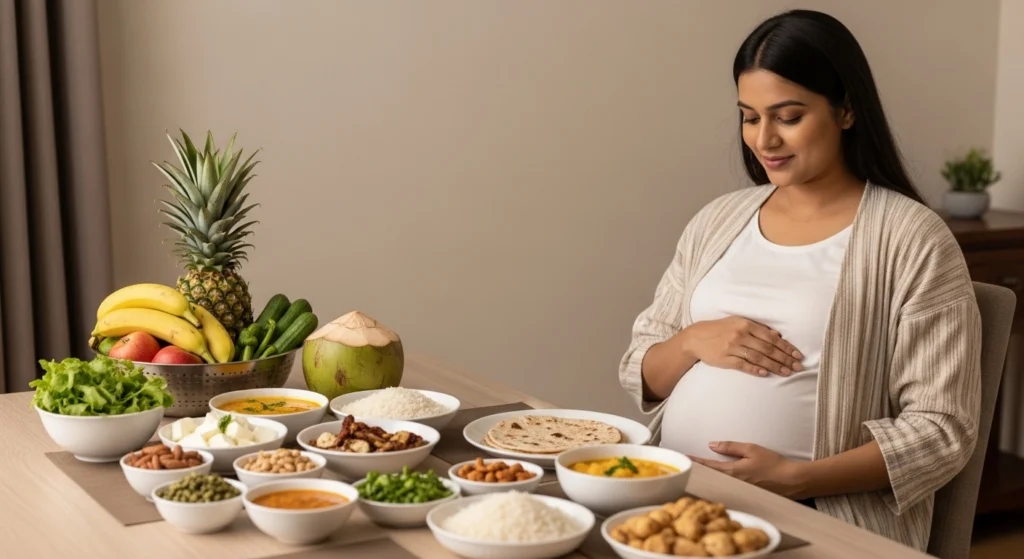
These are the foods we are asked about every week in Vashi. Each of them deserves a straight answer rather than a shrug, so here they are.
Myth
“Papaya causes miscarriage”
What is actually true
Ripe papaya is fine. The concern comes from the latex in unripe green papaya, which has been studied in animals at doses far beyond anything a person eats, and there is no human evidence of harm from ordinary amounts. Ripe papaya is a good source of fibre and folate, and constipation is one of the more miserable parts of pregnancy.
Myth
“Pineapple brings on labour”
What is actually true
The bromelain in pineapple is the basis of this one, and the amount in a normal serving is nowhere near enough to have any hormonal or uterine effect. You would have to eat an implausible quantity of core to test the theory. Enjoy it.
Myth
“Sesame, methi or jaggery are heating and unsafe”
What is actually true
The hot and cold framework is a cultural one rather than a physiological one, and no food raises core body temperature in a way that affects a pregnancy. Til, methi and gud are all ordinary foods with useful iron and calcium in them. There is no reason to remove them.
Myth
“Brinjal, jackfruit or drumstick should be avoided”
What is actually true
None of these appear on any evidence-based list anywhere. They are vegetables. If they are part of what you normally eat, keep eating them.
Myth
“Curd and buttermilk should be stopped, especially at night”
What is actually true
Curd made from pasteurised milk is one of the more useful things in an Indian pregnancy: protein, calcium and probiotics in a form that goes down easily when nausea is bad. There is no medical reason to stop it, at any hour.
Myth
“Saffron milk makes the baby fairer”
What is actually true
It does not. Skin colour is genetic and nothing eaten in pregnancy changes it. Saffron milk is pleasant and harmless, and this belief is worth naming plainly for what it carries rather than for any risk in the drink.
Our pregnancy myths and facts guide works through the rest of them, including the ones about the shape of the bump, heartburn and the sex of the baby.
More pregnancy-related stomach upsets in Navi Mumbai come from where food was prepared than from what it was. That is worth saying because it is where the actual risk sits, and it is the part that never makes it onto the family list.
The foods to avoid in pregnancy, the listeria, salmonella and toxoplasma risks behind them, the caution on liver and preformed vitamin A, the mercury advice on shark, swordfish and marlin, and the caffeine limit of 200 milligrams a day follow NHS and UK Food Standards Agency guidance on eating well in pregnancy, and NICE NG201 on antenatal care. The absence of evidence for harm from papaya, pineapple and similar foods reflects the absence of any human data supporting those claims rather than a positive finding of safety at extreme doses. This article is general information and does not replace an assessment with your own doctor.

Dr. Grishma Ranjangaonkar
MBBS, DGO · ICOG Fellowship in Gynecological Endoscopy · Maharashtra Medical Council Reg. No. 2014041327
Dr. Grishma has more than fifteen years of clinical experience and practises at Eva WomanCare Clinic in Vashi, seeing women from across Navi Mumbai including Kopar Khairane and Turbhe. Her work spans fertility and pregnancy care, PCOS and menstrual health, and keyhole gynecological surgery.
What to eat rather than what to avoid, across all three trimesters, built around Indian food.
The rest of the advice you will be given, taken one claim at a time.
What is normal week by week, and what to do when nausea decides your diet.
Due date, weight gain and the rest, in one place.
It takes about five minutes and it usually gives back half the foods someone has stopped eating. If you are pregnant in Vashi, Kopar Khairane, Turbhe or Nerul, this is a perfectly good thing to use part of an antenatal visit for.