Book it between six and eight weeks. Here is exactly what the forty minutes contains, what each blood test is for, and the five things you should not leave without.
Reviewed by Dr. Grishma Ranjangaonkar, MBBS, DGO, ICOG Fellowship in Gynecological Endoscopy · Eva WomanCare Clinic, Vashi, Navi Mumbai
People delay this appointment for reasons that make complete sense to them: waiting until the risky weeks pass, waiting to tell the family, or being told by a relative that the first visit is a formality. It is not a formality. The two things it does best, dating the pregnancy accurately and catching treatable problems early, both work considerably better the earlier they happen.
The short version
The right time for the first appointment is between six and eight weeks, counted from the first day of your last period. Not when you feel unwell, not at three months, and not once the pregnancy feels real. Before six weeks a scan often cannot see enough to be conclusive and you may simply be asked back; after ten or twelve, several of the things this visit is for have already slipped past their window.
People delay for reasons that make sense to them. Waiting until the risky period passes. Waiting to tell family first. Being told by a relative that the first visit is only a formality. It is not a formality, and the two things it does best, dating the pregnancy accurately and picking up treatable problems early, both work better the earlier they happen.
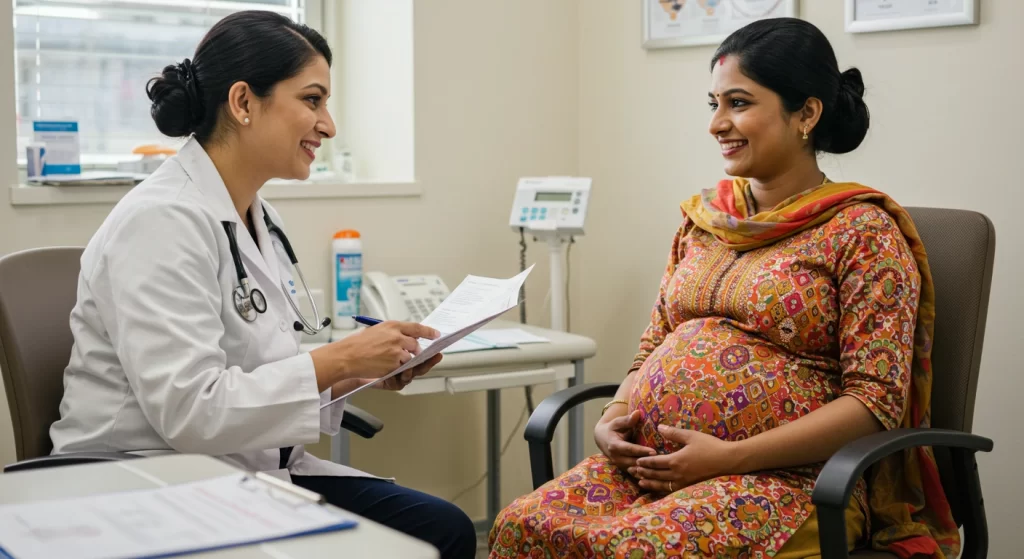
This is the part people find opaque, so here it is in plain terms. Every one of these is done for a specific reason, and each has a specific consequence if it comes back abnormal.
|
Test
|
What it is looking for
|
What happens if it is abnormal
|
|---|---|---|
Our pregnancy tests and scans guide lays out everything that follows across the forty weeks, in the order it happens.
A first-trimester scan measures the embryo from crown to rump, and at this stage every embryo grows at close to the same rate. That makes the measurement an unusually accurate way of dating a pregnancy, and it is why the scan date replaces the date calculated from your last period whenever the two disagree by more than a few days.
Accurate dates are not a detail. They set when your screening tests are valid, whether a baby is later called small or on time, and when a decision about induction is made. If your cycles were irregular, this scan is doing more work than usual. You can also run your own numbers with our due date calculator, though the scan is what will actually be used.
It can confirm the pregnancy is inside the uterus rather than in a tube, count how many there are, look for a heartbeat, and date the pregnancy. It cannot tell you the sex, and in India it is illegal for anyone to disclose it at any stage under the PCPNDT Act. It also cannot rule out most structural problems this early, which is what the twenty-week scan is for.

If you walk out with only a prescription, the visit has been half done. These are the five things worth checking you actually have before you go.
|
What
|
Why it matters
|
|---|---|
Myth
“An internal examination or a scan probe will disturb the pregnancy”
What is actually true
Neither does. A transvaginal scan in the first trimester is safe and often gives a much clearer picture than an abdominal one this early, particularly before eight weeks. It does not cause miscarriage and it does not touch the pregnancy.
Myth
“It is better to wait until three months, in case something goes wrong”
What is actually true
This is understandable and it works against you. If a pregnancy is going to end early, coming in does not change that. What coming in does change is finding an ectopic pregnancy in time, treating anaemia or a thyroid problem early, and getting the dates right.
Myth
“The first visit is only a formality, so any clinic will do”
What is actually true
The booking visit sets the baseline for everything that follows, including the blood pressure reading used to judge every later one. It is also where continuity starts. Changing doctor later is entirely possible, but this particular appointment is worth having somewhere you intend to stay.
Myth
“I should not tell the doctor about the traditional medicines I take”
What is actually true
Please do tell us. Nobody is going to lecture you. Some preparations contain hormones or heavy metals that are not on the label, and the only way that gets picked up is if we know about them.

The timing and content of the booking appointment, the routine first-trimester blood panel including haemoglobin, blood group and Rh status, thyroid function, blood sugar, HIV, hepatitis B and syphilis screening, and urine culture, and the use of first-trimester crown-rump length to determine gestational age all follow NICE NG201 on antenatal care and standard Indian antenatal practice. Non-disclosure of fetal sex at any stage is a requirement of the Pre-Conception and Pre-Natal Diagnostic Techniques Act 1994. This article is general information and does not replace an assessment with your own doctor.

Dr. Grishma Ranjangaonkar
MBBS, DGO · ICOG Fellowship in Gynecological Endoscopy · Maharashtra Medical Council Reg. No. 2014041327
Dr. Grishma has more than fifteen years of clinical experience and practises at Eva WomanCare Clinic in Vashi, seeing women from across Navi Mumbai including Kopar Khairane and Turbhe. Her work spans fertility and pregnancy care, PCOS and menstrual health, and keyhole gynecological surgery.
Every routine test across the forty weeks, in the order it actually happens.
What is normal week by week in the first twelve, and what needs a call today.
Work out your dates before the scan confirms them.
What actually matters to eat, trimester by trimester.
We keep the first appointment longer than a routine one, and we do the bloods and the dating scan in the same visit wherever possible rather than sending you back another day. If you have a positive test and you are in Vashi, Kopar Khairane, Turbhe or Nerul, this is the appointment to make now.