Why the timing window is strict, what the nasal bone adds, how to read the one-in-something number without misreading it, and what a higher-chance result actually leads to.
Reviewed by Dr. Grishma Ranjangaonkar, MBBS, DGO, ICOG Fellowship in Gynecological Endoscopy · Eva WomanCare Clinic, Vashi, Navi Mumbai
The nuchal translucency scan produces a number that a great many parents misread in one direction or the other, usually within minutes of receiving it. This is what the scan is measuring, what the report means line by line, and what actually happens next if the result comes back as a higher chance.
The short version
Every baby has a small layer of fluid at the back of the neck in early pregnancy. The scan measures the thickness of that layer in millimetres. It is called the nuchal translucency, and on its own it means very little. Combined with two hormones from your blood and your age, it produces a single number: a chance, written as one in something.
That distinction matters more than anything else on this page. This is a screening test. It sorts pregnancies into higher chance and lower chance. It does not diagnose anything, in either direction.
The nuchal fluid layer is present in a specific stretch of early pregnancy and then resolves. That is why the appointment cannot be moved to suit a work schedule.
|
|
When
|
What it depends on
|
|---|---|---|
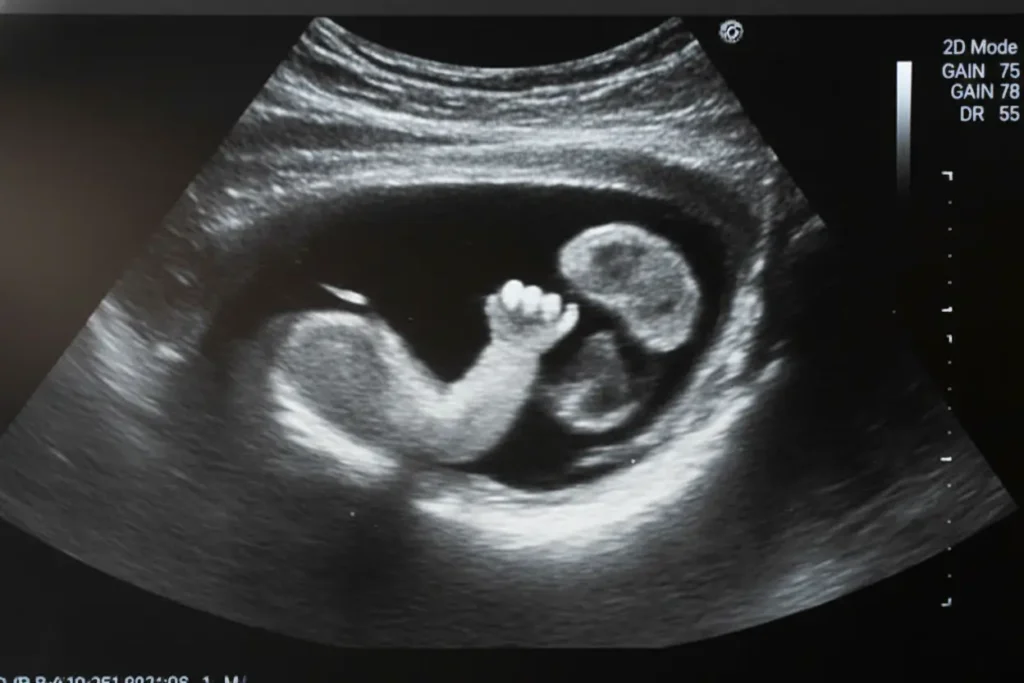
Many centres in India report NT and NB together, which is why the scan is often booked under that name. The nasal bone is exactly what it sounds like: the sonographer checks whether it is visible at this stage.
An absent or underdeveloped nasal bone at this point is associated with a higher chance of Down syndrome, so where it is included it refines the risk calculation. What it is not is a verdict. Plenty of entirely healthy babies have a nasal bone that is simply not yet clearly visible, and the finding is interpreted alongside everything else rather than on its own.
Reports vary between centres, but the same handful of terms appear on nearly all of them.
|
What it says
|
What it means
|
|---|---|
Nothing happens automatically, and nothing has to be decided in the room. The options below are yours to take or decline, in any combination.
|
Option
|
What it is
|
What to know
|
|---|---|---|

Every registered scan centre in India displays a notice stating that determining the sex of the fetus is illegal. That is the PCPNDT Act, and it applies to this scan as much as to any other.
Myth
“A thick NT means the baby has Down syndrome.”
What is actually true
It does not. A larger measurement raises the calculated chance and is a reason for further testing, and plenty of babies with an increased NT are entirely healthy. Only a diagnostic test can confirm or exclude anything.
Myth
“A low-chance result means everything is fine.”
What is actually true
It means the chance is low, which is genuinely reassuring, and it is not a guarantee. Screening tests miss a small proportion of cases, which is why the anomaly scan at around twenty weeks still matters.
Myth
“The scan can tell you the sex.”
What is actually true
It could, technically, and it will not. Sex determination is illegal in India under the PCPNDT Act and no registered centre will do it.
Myth
“If I miss the window there is nothing I can do.”
What is actually true
There is. The quadruple test runs from about 14 to 20 weeks, and NIPT can be done from around 10 weeks onwards. The combined test is the best first option, not the only one.
Myth
“The scan is dangerous for the baby.”
What is actually true
Ultrasound in pregnancy has been in routine use for decades with no established harm at diagnostic settings. The scan itself carries no risk to the pregnancy. Only the diagnostic tests, CVS and amniocentesis, carry a procedural risk.

The combined test window, the crown-rump length range for measuring nuchal translucency, the markers used and the commonly applied 1 in 150 cut-off follow UK national screening practice as summarised in standard clinical references. Quoted miscarriage risks of roughly 1 in 200 for chorionic villus sampling and amniocentesis, and detection rates above 99 percent for NIPT in trisomy 21, come from the same body of practice. The legal position on fetal sex determination in India is the PCPNDT Act 1994. This article is general information and does not replace advice from your own doctor, who has your scan and your results.

Dr. Grishma Ranjangaonkar
MBBS, DGO · ICOG Fellowship in Gynecological Endoscopy · Maharashtra Medical Council Reg. No. 2014041327
Dr. Grishma has more than fifteen years of clinical experience and practises at Eva WomanCare Clinic in Vashi, seeing women from across Navi Mumbai including Kopar Khairane and Turbhe. Her work spans fertility and pregnancy care, PCOS and menstrual health, and keyhole gynecological surgery.
Every routine test across the forty weeks, and how to read a scan report.
Weeks 1 to 12: what is forming, why each symptom happens, and the signs that need a call today.
Dating decides whether the NT can be measured today. This gives the realistic range around your date.
Sorted by urgency: what means go now, what means call today, what can wait.
A number on a page is a poor way to receive news of any kind. If your NT report has come back and you are not sure what it means, or the result was a higher chance and nobody explained the options properly, that is a conversation worth having in person.